



Most companies I meet have already bought good software. The finance system works. The CRM works. The HR platform works. Each one was chosen carefully, implemented properly, and does what it was bought to do.
And yet the same complaint comes up in almost every conversation: nothing moves fast enough, and nobody can say why.
The reason is usually structural, and it has very little to do with the quality of the software.
Each of them also has approvals built in. The finance system can route a purchase order for sign-off. The CRM can require an approval on a discount. Those approvals work well, because the system holds all the information the decision needs.
The problem starts when a decision needs information from more than one of them.
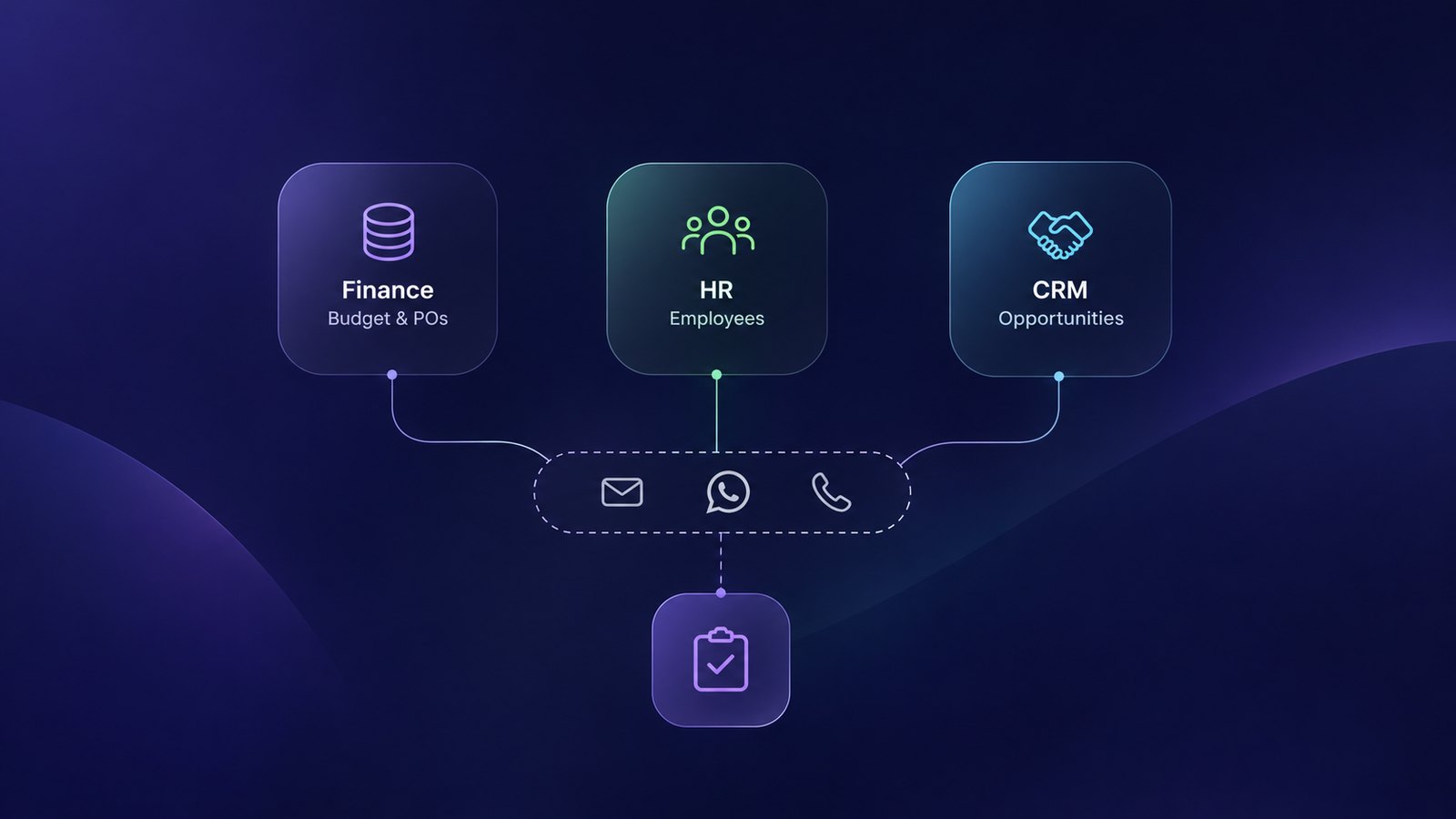
The seam Consider a fairly ordinary situation. A site needs material. The requirement originates in a project schedule. The vendor and the rate sit in a procurement record. The budget position sits in finance. Whether this particular vendor is still within its credit limit sits somewhere else again.
Somebody has to decide whether to release the order.
No single system can hold that decision, because no single system can see all four things. So the decision leaves software entirely. It becomes an email. Then a WhatsApp message, because the email did not get a reply. Then a phone call, because the message did not either.
This is the seam. It is not a gap in any product. It is the space between products, and it appears wherever a decision depends on the state that lives in more than one place.
Messaging becomes the fallback for a simple reason: it is the only medium that does not care which system the data lives in. A WhatsApp group will happily carry a decision that spans four systems. That is exactly why it wins, and exactly why it costs so much.
What the seam actually costs The process becomes invisible — no system holds the record, so no system can report on it. If the approval took nine days, nothing anywhere knows that. The delay becomes unattributable, because there is no timestamp on a decision that happened in a chat thread. The audit trail breaks exactly where the risk is highest: approvals inside a system are logged, approvals across systems are not, so the decisions with the most money attached tend to be the ones with the least evidence behind them. And it gets worse as you buy more software, not better — two systems create one seam, five create ten, ten create forty-five. Every well-chosen new tool adds capability inside its own boundary and adds seams outside it.
Why the usual remedies do not hold Integration moves data between systems, and does it well — but moving data is not the same as moving a decision. Point automation automates a single step, but the delay is rarely in a step; it is in the handover between steps. Extending the system of record works when a process lives entirely inside one system’s domain, and inherits the same limitation when it does not. Adding an assistant on top can read from several systems and summarise — useful — but if the underlying process still has no home, the assistant is describing the fragmentation rather than resolving it. None of these are bad tools. They are tools aimed at a different problem.
What resolves it The work that crosses systems needs somewhere to live. Not a copy of the data, not a message about the data, but the process itself held as a real object — one place holding the data the process needs, the rules that govern it, the routing and approvals, the connections to the systems of record, the interface people use, and the audit trail, together.
Two things follow, and both matter. The systems of record stay exactly where they are, authoritative about their own objects. Nothing needs to be ripped out — and any approach that begins by requiring that should be treated with suspicion. The general ledger, specifically, stays where it is; the operational layer sits around it. What changes is that the work between systems stops being invisible. It has a timestamp, an owner, a state, and a record. Once that exists, the nine days become measurable, and measurable delays tend to shrink without anyone being asked to work harder.
How to tell whether this applies to you Can you say how long your last twenty approvals of any given type took, without asking anyone? When a decision crosses two departments, where is it recorded? If the person who handles that decision left tomorrow, would anyone know what was waiting on them?
If those three questions land uncomfortably, the issue is almost certainly not the software you have bought. It is that the work between your software has nowhere to live.